
One answer versus extra copies
These examples use a 20-card deck, no Innate cards, five opening draws and five more cards on turn 2. Every target copy supplies the same answer. Energy costs and play restrictions can still prevent using it.
Use a preset to compare another starting state:
Innate takes a slot and leaves the random pool
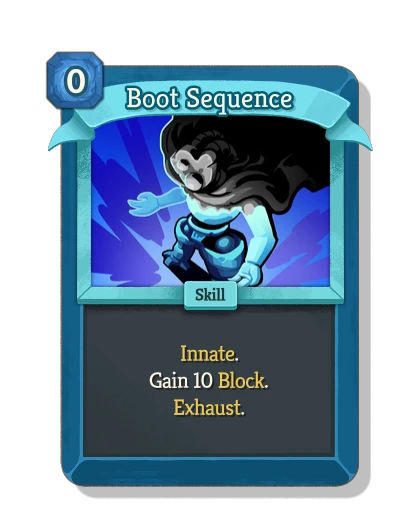
Boot Sequence starts combat in hand. If it is one of your targets, set both the Innate count and the matching target count. If you seek another card, Boot Sequence instead leaves fewer random opening slots.
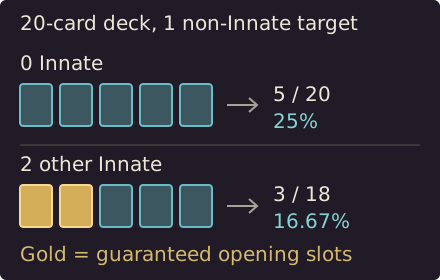
Two other Innate cards in the 20-card example leave three random draws from eighteen cards: 3/18, or 16.67%. A guaranteed target gives 100% access in the opening instead. The model requires all entered Innate cards to fit; excess-Innate ordering is outside this calculation.
Retain, bonus draws and restrictions
Equilibrium retains the hand for that turn. Eight held cards leave two free slots under the entered ten-card capacity. To compare a fixed starting state, set the opening total to eight and the held count to eight. Two more cards on turn 2 bring the total seen to ten: a 50% chance for one random target in twenty.
This is a fixed occupancy example. Change the held count if you play or discard those cards. The chance of having seen a target does not say whether it remains held.
Bag of Preparation adds two combat-start draws; include them in the opening total once. Battle Trance prevents further draws that turn after resolving. Enter only completed or certain draws. Do not count a draw card you first need to find: the number drawn must be the same across the shuffles you compare. This calculator does not decide whether a conditional draw effect can be played.
Boot Sequence and opening slots compares one or two Innate cards, a fixed 20-card deck and Bag of Preparation’s extra draws.
Formula and first-reshuffle boundary
After removing guaranteed cards, let N be the random pool, K its target copies and n the new cards seen. The chance of at least one target is:
P = 1 − C(N − K, n) / C(N, n)
C(a, b) counts ways to choose b cards from a. The calculation uses exact integer combinations and reduces the fraction. Displayed percentages round to two decimal places, but only impossible or guaranteed draws show 0% or 100%.
The by-turn sample is the random opening count, plus later regular draws limited by free hand slots, plus the entered extra draws. It assumes a uniform shuffle and no pile changes, targeted retrieval or reshuffle. Once the requested count exceeds the original random pool, the by-turn result stops. Use reshuffle timing for effects that cross that boundary and opening-hand decisions for access versus playable resources.
The damage and Block calculator compares the ordinary hits and defense of cards already available to play. It keeps separate card gains and per-hit rounding.