Grand Finale needs an empty draw pile for a manual play. It also needs to be in your hand when that happens. Emptying the pile while Finale sits in discard accomplishes neither task. Start by separating access to Finale from control over the remaining draw count.
The base card costs zero Energy and deals 60 damage to each enemy; its upgrade deals 75. Extra damage helps only after the condition is met. An upgrade to a draw card can change whether you reach that condition at all.
Two cards left: Backflip versus Acrobatics
Assume Finale is already in hand. Exactly two cards remain in the draw pile, at least three cards are in discard, and you have room for all requested draws. No relic, Power or discarded card adds extra draw. You have at least one Energy.
Backflip costs one Energy and draws two. Those are the final two cards. The draw pile reaches zero, the draw effect finishes, and you can play Grand Finale for 60 damage to every enemy. Backflip also supplies its five base Block if the combat continues.
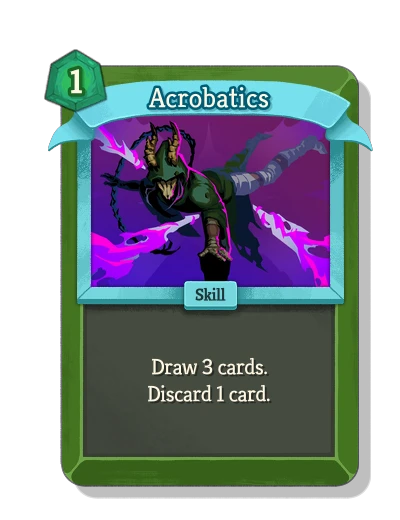
Base Acrobatics costs the same one Energy but requests three cards. The first two empty the original pile. The third draw requires a reshuffle; cards from discard form a new draw pile, and at least two remain after that draw. The later discard choice does not remove those remaining draw-pile cards. Grand Finale is no longer manually playable at that point.
This hand needs exactly two draws; a third crosses the reshuffle. If you already have a legal Finale window, use it before drawing again unless another verified effect makes the later line better.
Three cards left: an upgrade changes the answer
| Draw pile before the play | Draw effect | Result under the same assumptions |
|---|
| 2 cards | Backflip: draw 2 | Stops at zero; Finale window opens |
| 2 cards | Acrobatics: draw 3 | Crosses a reshuffle; window closes |
| 3 cards | Base Acrobatics: draw 3 | Stops at zero; Finale window opens |
| 3 cards | Acrobatics+: draw 4 | Crosses a reshuffle; window closes |
| 3 cards | Prepared draw 1, then Backflip draw 2 | Can stop at zero while keeping Finale |
That last line needs both cards available, one Energy for Backflip, and a safe discard choice for Prepared. An extra draw from a discarded Reflex changes the count. Discarding Finale itself changes access. Track the complete sequence rather than adding only the printed draw numbers.
The table does not mean Acrobatics should stay unupgraded in every Finale deck. Drawing four finds more cards on other turns, and the rest of the deck may supply the one-card adjustments a particular hand needs. It means the upgraded copy must be counted as four when planning this turn.
Retain the payoff without filling the hand
Well-Laid Plans is a Rare 2-Energy Power since v0.111.1 (1 upgraded): you stop discarding your hand at the end of your turn, so Finale stays in hand along with every other card. Before that update it retained only 1 card (2 upgraded) for 1 Energy. Runic Pyramid also keeps cards available, but a clogged hand can reduce the draws you can actually complete. Check the open hand slots as well as the size of the draw pile.
Phantom Blades can retain Shivs. Those cards can occupy space you intended to use for the next opening draw; they can also be played to free space when that preserves the plan. The retained Shiv defense guide covers reasons to save them that are independent of Finale.
Calculated Gamble draws according to the hand it discards. It can adjust access and counts, but if Finale is among the discarded cards, you need to retrieve or redraw it as well. Its Exhaust keyword also prevents assuming that one copy will repeat forever. The upgrade adds Retain; it does not remove Exhaust.
Draft support that still works when Finale does not
A deck can benefit from Backflip, Acrobatics and selective retention before it can reliably play Finale. The reverse is less forgiving: taking Finale first does not create the draw control it needs. A second copy adds another payoff that must reach hand; it does not itself solve the first copy’s access problem.
Before adding more support, find a specific failure in recent turns. Was Finale missing, was the draw count wrong, did an extra draw cross the shuffle, or did setup leave no defense? Fix that failure without discarding the cards that handle ordinary fights. The Sly guide explains a functional discard engine that need not depend on Finale.
A legal play is not proof of a sustainable loop. For repeated uses, identify how Finale returns to hand, how the draw pile reaches zero again, and which resources change after every cycle. The loop resource checks demonstrate that accounting with a different character. The reshuffle timing guide explains why the card currently resolving cannot simply draw itself back.